Bartleby, The Scrivener: A Story of Wall-Street, by Herman Melville
Bartleby, The Scrivener: A Story Of Wall-Street, By Herman Melville. The developed technology, nowadays support everything the human requirements. It consists of the daily activities, jobs, office, entertainment, and also more. Among them is the excellent website connection as well as computer system. This problem will alleviate you to support one of your leisure activities, reviewing behavior. So, do you have eager to read this book Bartleby, The Scrivener: A Story Of Wall-Street, By Herman Melville now?
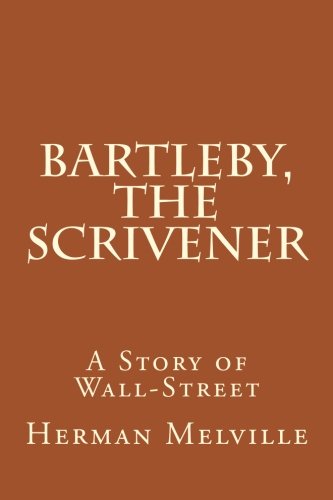
Bartleby, The Scrivener: A Story of Wall-Street, by Herman Melville

Best Ebook PDF Online Bartleby, The Scrivener: A Story of Wall-Street, by Herman Melville
This Bishopston Large Print Edition of Herman Melville's famous novella is set in 18 point Book Antiqua font, for easy reading by the visually impaired. The text has been fully revised and formatted for optimum reading pleasure.
Bartleby, The Scrivener: A Story of Wall-Street, by Herman Melville- Published on: 2015-09-08
- Format: Large Print
- Original language: English
- Number of items: 1
- Dimensions: 9.00" h x .24" w x 6.00" l, .34 pounds
- Binding: Paperback
- 106 pages
Review ''Herman Melville is one of American literature's greatest figures.'' --The Cambridge Guide to Literature in English
About the Author Herman Melville was an American novelist, poet, and lecturer best known for his classic novel Moby-Dick, as well as for his short fiction "Bartleby, the Scrivener," and the unfinished "Billy Budd, Sailor." Educated as a teacher and later as an engineer, Melville s writing was heavily influenced by his time aboard the whaling ship Acushnet, and his month-long captivity by Typee natives on Nuka Hiva island. Although Melville experienced success early in his writing career, public indifference to his masterpiece, Moby-Dick, resulted in waning attention, and his work was almost entirely disregarded by the time of this death in 1891. Melville s work experienced a revival in the early twentieth century, and he is now considered one of the pre-eminent American writers of his time. He is also one of the most-studied novelists, and was the first writer to be collected and published by the Library of America.

Where to Download Bartleby, The Scrivener: A Story of Wall-Street, by Herman Melville
Most helpful customer reviews
49 of 50 people found the following review helpful. Complete text of Melville's humorous and moving novella on humanity By D. Summerfield This review is for the free Kindle edition of this novella. The novella is available for purchase in several book formats, some of which contain excellent critical essays on this important American author and his work. This Kindle edition contains only the text of the novella, but it is free and that's great."Bartleby the Scrivener" is a very accessible short novella by the author of "Moby Dick." It tells the story of a strange young man named Bartleby who shows up one morning at a New York law firm and is employed as a copyist (scrivener.) In those days (mid-nineteenth century), legal work was horrendously tedious for the clerks since huge briefs and depositions had to be copied by hand by men who did nothing all day but write a clear hand (and try not to leave ink blots on the paper,) and then check their work by reading it aloud back to each other.This is one of my favorite novellas (really a long short story). Wittily narrated by the harassed lawyer who owns the law firm, it describes the characters of those copyists who are employed there, and tells of the strange Bartleby who just decides to stop doing any work one day, telling his exasperated employer that he "prefers not to."The story is a wonderful mixture of high comedy, pathos and fascinating commentary on the human condition. I re-read it at least once a year, and I always enjoy it and get something fresh from Melville's wise insights and his wonderful wit.Highly recommended.
24 of 25 people found the following review helpful. A Literary Innovation: the Clueless Narrator By Gio "Bartleby" is strictly speaking just a magazine sketch, one of a batch of informal sketches from magazines reprinted together as The Piazza Tales. It has the format of a memoir of an eccentric character, Bartleby, as told by a nameless first-person narrator, "an eminently safe man" by his own account, a lawyer who earns his living through the most mundane, routine legal paperwork, who also complains that 'reformers' have deprived him of his lucrative sinecure in state government. "I am a man who, from his youth upwards, has ben filled with a profound conviction that the easiest way of life is the best," he says of himself. In short, in this "Story of Wall Street", he is a drone, a financial parasite, and he would have been recognized as such by Melville's readership in the 1850s, a era when Wall Street was regarded with as much suspicious as in 2009. He is also a smug, sanctimonious, cautious man, irritably comfortable to exploit the labor of his copyists, one of whom is an impaired alcoholic and the other perhaps a pre-medication psychotic. When the third impaired eccentric, Bartleby, joins the staff, our Narrator is readily 'generous' in tolerating him as long as he can make a dime. It seems to me fairly obvious that we readers are supposed to treat the Narrator with distrust, perhaps even dislike.Melville wrote at the beginning of the now-established literary tradition of the 'unreliable narrator', supplanting the omniscient narrator of the majority of 19th C novels. But Melville transcends that tradition in his first effort, giving us a 'clueless' narrator, an observer who is honest only in his acknowledgement of his complete non-understanding of his subject. To accept the Narrator's analysis of Bartleby would be a fatal error of readerly judgement. Whatever Melville's subtext in this story -- whatever Melville wants to tell us -- that Narrator is the one person who can't possibly be expected to comprehend it.Melville also wrote at the end of the ancient tradition of 'allegory.' His only literary peer and friend, Nathaniel Hawthorne, was the grand master of slyly allegorical short tales, and it makes sense to examine Bartleby as a specimen of the allegorical genre. Thus we need to ask who the Narrator figures for, and who the Scrivener, and then what it is, really, that Bartleby "prefers" not to participate in. My interpretation is that N represents the entire commercial/financial culture of 19th C America, while Bartleby embodies all those who are aliens within that system, first by necessity and then by bitter choice. Bartleby, in effect, prefers not to be a link in that chain, a cog in that machine.Another school of literary criticism would examine Melville's personal life for clues of his authorial intentions. It's widely known that Melville was finding his inability to "make a decent living and support his family" both frustrating and frightening during the decade after the commercial failure of Moby Dick. In fact, Melville found himself on the verge of becoming a patronage drone, a place-holder in the New York Customs Office. It may be important to realize that Melville's father-in-law, Justice Lemuel Shaw of the Massachusetts Supreme Court, was both an extremely powerful man in America at the time, and a man of energetic personal forcefulness. It's hard to believe that Melville was not intimidated and oppressed by Shaw, yet no more able to make a case for himself than poor Bartleby.I'm just tossing off suggestions here, my friends. Bartleby is an enigma wrapped in complexity, and no final interpretation would stand up to a second reading. When I first read it, in the 1960s, it was still neglected and overshadowed among Melville's works by "Billy Budd". It's been interesting to watch the emergence of recognition among readers that Bartleby is one of the greatest short masterpieces of the English language.One thing more to say about Bartleby is that it's marvelously funny. It's Herman Melville's best assimiliation of the ludricrous style of Charles Dickens and other Victorian writers. The first dozen pages, before the appearance of Bartleby, are devoted to comedy in the form of exaggerated portrayals of the three hapless employees of the nameless narrator. Each of these comic-relief figures will be brought back into service at intervals in the subsequent tale. It's supremely important, dear reader, to recognize Melville's sardonic humor; other reviewers who rated Bartleby at two stars or less clearly "didn't get the joke."
22 of 23 people found the following review helpful. Seemingly simple story about the choices we make daily By Linda Linguvic Herman Melville wrote this story in 1853, two years after Moby Dick had been published and his writing career was beginning to lose its luster. Subtitled, "A Story of Wall Street", it is a seemingly simple story about a lawyer who hires a gentleman named Bartleby as a scrivener in his office. This was way back in the days before photocopy machines and scriveners performed the necessary tasks of tediously hand copying documents over and over. Bartleby was good at the copying part of his job, but when asked to proofread aloud one day he simply replied, "I prefer not to." From that moment forward, he used the phrase "I prefer not to" for every task requested of him, eventually "preferring not to" do any work whatsoever. The lawyer, who is astounded by Bartleby's attitude, tells the story in the first person.The story is rich in language and yet spare in actual action. The reader is forced to think, and think seriously about the choices we make daily. Bartleby chose to rebel and become an anti-hero. But the real protagonist of the story is the lawyer, who is drawn into Bartleby's power and grows to admire him. The conclusion is sad, but inevitable. Recommended.
See all 80 customer reviews... Bartleby, The Scrivener: A Story of Wall-Street, by Herman MelvilleBartleby, The Scrivener: A Story of Wall-Street, by Herman Melville PDF
Bartleby, The Scrivener: A Story of Wall-Street, by Herman Melville iBooks
Bartleby, The Scrivener: A Story of Wall-Street, by Herman Melville ePub
Bartleby, The Scrivener: A Story of Wall-Street, by Herman Melville rtf
Bartleby, The Scrivener: A Story of Wall-Street, by Herman Melville AZW
Bartleby, The Scrivener: A Story of Wall-Street, by Herman Melville Kindle
Tidak ada komentar:
Posting Komentar