Old VenusFrom Martin, George R. R. (EDT)/ Dozois, Gardner (EDT)
Based on some experiences of lots of people, it remains in truth that reading this Old VenusFrom Martin, George R. R. (EDT)/ Dozois, Gardner (EDT) can help them to make far better selection and also offer more encounter. If you want to be among them, let's purchase this publication Old VenusFrom Martin, George R. R. (EDT)/ Dozois, Gardner (EDT) by downloading guide on link download in this site. You could obtain the soft data of this book Old VenusFrom Martin, George R. R. (EDT)/ Dozois, Gardner (EDT) to download and also deposit in your offered digital devices. What are you waiting for? Allow get this book Old VenusFrom Martin, George R. R. (EDT)/ Dozois, Gardner (EDT) on the internet and read them in whenever and also any location you will review. It will certainly not encumber you to bring hefty book Old VenusFrom Martin, George R. R. (EDT)/ Dozois, Gardner (EDT) inside of your bag.
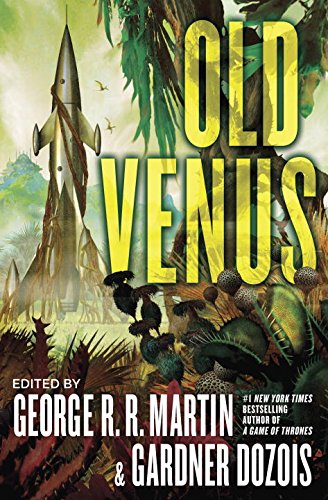
Old VenusFrom Martin, George R. R. (EDT)/ Dozois, Gardner (EDT)

Ebook PDF Old VenusFrom Martin, George R. R. (EDT)/ Dozois, Gardner (EDT)
Sixteen all-new stories by science fiction’s top talents, collected by bestselling author George R. R. Martin and multiple-award-winning editor Gardner Dozois From pulp adventures such as Edgar Rice Burroughs’s Carson of Venus to classic short stories such as Ray Bradbury’s “The Long Rain” to visionary novels such as C. S. Lewis’s Perelandra, the planet Venus has loomed almost as large in the imaginations of science fiction writers as Earth’s next-nearest neighbor, Mars. But while the Red Planet conjured up in Golden Age science fiction stories was a place of vast deserts and ruined cities, bright blue Venus was its polar opposite: a steamy, swampy jungle world with strange creatures lurking amidst the dripping vegetation. Alas, just as the last century’s space probes exploded our dreams of Mars, so, too, did they shatter our romantic visions of Venus, revealing, instead of a lush paradise, a hellish world inimical to all life. But don’t despair! This new anthology of sixteen original stories by some of science fiction’s best writers—edited by #1 New York Times bestselling author George R. R. Martin and award-winning editor Gardner Dozois—turns back the clock to that more innocent time, before the hard-won knowledge of science vanquished the infinite possibilities of the imagination. Join our cast of award-winning contributors—including Elizabeth Bear, David Brin, Joe Haldeman, Gwyneth Jones, Mike Resnick, Eleanor Arnason, Allen M. Steele, and more—as we travel back in time to a planet that never was but should have been: a young, rain-drenched world of fabulous monsters and seductive mysteries. FEATURING ALL-NEW STORIES BY Eleanor Arnason • Elizabeth Bear • David Brin • Tobias S. Buckell • Michael Cassutt • Joe Haldeman • Matthew Hughes • Gwyneth Jones • Joe R. Lansdale • Stephen Leigh • Paul McAuley • Ian McDonald • Garth Nix • Mike Resnick • Allen M. Steele • Lavie Tidhar And an Introduction by Gardner Dozois
Old VenusFrom Martin, George R. R. (EDT)/ Dozois, Gardner (EDT)- Amazon Sales Rank: #251600 in Books
- Brand: Martin, George R. R. (EDT)/ Dozois, Gardner (EDT)
- Published on: 2015-03-03
- Released on: 2015-03-03
- Original language: English
- Number of items: 1
- Dimensions: 9.50" h x 1.60" w x 6.30" l, 1.97 pounds
- Binding: Hardcover
- 608 pages
About the Author George R. R. Martin is the #1 New York Times bestselling author of many novels, including the acclaimed series A Song of Ice and Fire—A Game of Thrones, A Clash of Kings, A Storm of Swords, A Feast for Crows, and A Dance with Dragons—as well as Tuf Voyaging, Fevre Dream, The Armageddon Rag, Dying of the Light, Windhaven (with Lisa Tuttle), and Dreamsongs Volumes I and II. He is also the creator of The Lands of Ice and Fire, a collection of maps from A Song of Ice and Fire featuring original artwork from illustrator and cartographer Jonathan Roberts, and The World of Ice & Fire (with Elio M. García, Jr., and Linda Antonsson). As a writer-producer, Martin has worked on The Twilight Zone, Beauty and the Beast, and various feature films and pilots that were never made. He lives with the lovely Parris in Santa Fe, New Mexico. Gardner Dozois has won fifteen Hugo Awards and thirty-two Locus Awards for his editing work, plus two Nebula Awards for his own writing. He was the editor of Asimov’s Science Fiction for twenty years, and is the author or editor of more than a hundred books, including The Year’s Best Science Fiction.
Excerpt. © Reprinted by permission. All rights reserved. Allen M. SteeleIn the suspenseful story that follows, we accompany a tough PI to Venus on a risky mission that takes him down some very Mean Streets indeed—even if, on Venus, there aren’t any streets.Allen Steele made his first sale to Asimov’s Science Fiction magazine in 1988, soon following it up with a long string of other sales to Asimov’s, as well as to markets such as Analog, The Magazine of Fantasy & Science Fiction, and Science Fiction Age. In 1989, he published his critically acclaimed first novel, Orbital Decay, which subsequently won the Locus Poll as Best First Novel of the year, and soon Steele was being compared to Golden Age Heinlein by no less an authority than Gregory Benford. His other books include the novels Clarke County, Space, Lunar Descent, Labyrinth of Night, The Weight, The Tranquillity Alternative, A King of Infinite Space, Oceanspace, Chronospace, Coyote, Coyote Rising, Spindrift, Galaxy Blues, Coyote Horizon, and Coyote Destiny. His short work has been gathered in three collections, Rude Astronauts, Sex and Violence in Zero-G, and The Last Science Fiction Writer. His most recent books are a new novel in the Coyote sequence, Hex, a YA novel, Apollo’s Outcasts, an alternate history, V-S Day, and the collection Sex and Violence in Zero-G: The Complete “Near Space” Stories: Expanded Edition. He has won three Hugo Awards, in 1996 for his novella “The Death of Captain Future,” in 1998 for his novella “. . . Where Angels Fear to Tread,” and, most recently, in 2011 for his novelette “The Emperor of Mars.” Born in Nashville, Tennessee, he has worked for a variety of newspapers and magazines, covering science and business assignments, and is now a full-time writer living in Whately, Massachusetts, with his wife, Linda.FrogheadsAllen M. SteeleThe shuttle fell through the clouds—clouds as dense as grey wool, separating purple sky and sun above from perpetual rain below—for what seemed like a very long time until the windows finally cleared and Venus’s global ocean lay revealed: dark blue, storm-lashed, endless.Engines along the spacecraft’s boatlike underbelly fired, forming a concentric circle of white-peaked wavelets that spread outward upon the ocean surface. Gradually the shuttle made its final descent until its hull settled upon the water. As careful as the pilots were, though, the splashdown was rough. A swift, violent jolt passed through the passenger compartment, shaking everyone in their seats, causing an overhead storage compartment to snap open and spill a couple of carry-on bags into the center aisle. Through the compartment, people cursed—mainly in Russian although a few American obscenities were heard as well—and someone in the back noisily threw up, an involuntary act that was greeted by more foul language.Ronson wasn’t happy about the landing either. This wasn’t the first time he’d traveled off-world, but landing on Mars was mild compared to this. He couldn’t blame the guy a few rows back for getting sick. Although the shuttle was no longer airborne, it still remained in motion, slowly bobbing up and down as it was rocked by the ocean. He’d been warned to take Dramamine before boarding, and he was glad he’d heeded the advice.Clutching the armrests, Ronson gazed through the oval porthole beside his seat. Rain spattered the outer pane, but he could still see where he was. Not that there was much to look at: ocean for as far as the eye could see—the Venusian horizon was about three miles away, nearly the same as Earth’s at sea level—beneath a slate-colored sky bloated by clouds that had never parted and never would. The shuttle was supposed to make planetfall at Veneragrad, but the floating colony must be on the other side of the spacecraft. Unless, of course, the pilots had miscalculated the colony’s current position and had come down—landed wasn’t the proper word, was it?—in the wrong place.That was a possibility. Ronson had spent the last four months in hibernation, but his waking hours aboard the Tsiolkovsky had shown him that Cosmoflot’s reputation for ineptitude was well deserved. He’d just begun to consider the possibility that the shuttle was lost at sea when a tugboat came into view. Smoke belching from its funnel, the rust-flecked craft circled the shuttle until it passed out of sight once again. Several minutes went by, then there was a thump as its crew attached a towline to the shuttle’s prow. The shuttle began to move forward again, the tug hauling it toward its final destination.Everyone on his side of the passenger compartment peered through the windows as the shuttle pulled into Veneragrad, including the middle-aged Russian in the aisle seat who unapologetically leaned over Ronson as he craned his head for a look at the man-made island. Veneragrad was as utilitarian as only a Soviet-era artifact could be: a tiered hemisphere a kilometer in diameter, a shade darker than the ocean it floated upon, the long, wooden piers jutting out from its sides giving it the appearance of an enormous, bloated water spider. Rickety-looking platforms, also constructed of native timber, rose as irregularly spaced towers from the outside balconies; they supported the open-top steel tanks that caught the rain and distilled it as the colony’s drinking water. Radio masts and dish antennae jutted out at odd angles from near the top of the dome; a helicopter lifted off from a landing pad on its roof. An ugly, unwelcoming place.“Looks bad, yes?” The man seated beside him stared past him. “Better than nothing . . . it’s dry.”Ronson had already learned that his traveling companion spoke English, albeit not very well. His breath reeked of the vodka he swilled from a bag-wrapped bottle on the way down from orbit; he’d opened it as soon as the shuttle entered the atmosphere. “Is this where you live?” he asked, if only for the sake of being polite. “Is this your home, I mean?”The other man barked sullen laughter. “This hellhole? No! My home, St. Petersburg. Come here to make money. Sell . . . um . . . ah”—he searched for the right word—“computers, yes? Computers for office.”Ronson nodded. He wasn’t much interested in making friends with the businessman, but it appeared that conversation was unavoidable. “Whole colony, built in space above Earth, sent here by rockets,” the businessman continued, telling Ronson something he already knew. “Dropped from orbit by para . . . para . . .”“Parachutes.”“Parachutes, yes. Come down”—he lifted his hands—“sploosh! in water.” He waved the bag toward the window. “People then build onto it. Wood from floating . . . um, forests, yes? Floating forests on moss islands.”“Yes, I see.” Again, the businessman wasn’t telling him anything new.“Yes, you see.” The Russian took another swig from his bottle, then offered it to Ronson. “So why you come here?”Ronson shook his head at the bottle. There were several ways he could get out of this unwanted conversation. He opted for the easiest approach. “I’m a detective,” he said, and when the businessman gave an uncomprehending look, he rephrased his answer in simpler, if inaccurate, terms. “A cop.”“A cop. Yes.” The businessman gave him the distrustful look Ronson anticipated, then withdrew the bottle and settled back into his seat.Ronson didn’t hear from him again for the rest of the way into port. Which suited him well. He didn’t want to talk about why he’d come to Venus.The heat hit him as soon as he stepped through the hatch. It was like walking into a sauna; the air was hot and thick, hard to breathe, humid beyond belief. The sun was larger and warmer here than on Earth, yet little more than a bright smear in the sky that heated up the atmosphere. Ronson began to sweat even before he reached the end of the wooden gangway that led from the hatch to the pier where the shuttle had been berthed. A fine, almost misty rain was falling, and it too was warm; he didn’t know whether to take off the denim jacket he’d worn on the way down or keep it on. The dockworkers didn’t seem to mind. Most of them wore only shorts, sneakers, and sometimes a rain hat, with the women wearing bikini tops or sports bras. They unloaded the bags from the cargo bay, and Ronson took a few moments to find his suitcase before walking the rest of the way down the pier to the spaceport entrance.There were only a couple of customs officers on duty, bored-looking Russians in short-sleeve uniform shirts who regarded the line of passengers with bureaucratic disdain. The officer Ronson approached silently examined his passport and declaration form, gave his face a quick glance, then put his stamp on everything and shrugged him toward an adjacent arch. No one had asked him to open his bag, but he knew what was about to happen. Sure enough, bells rang from the arch as soon as he walked through it. Its weapons detector had found the gun he was carrying.Just as well. It only meant that he’d meet the police sooner than he had planned.An hour of sitting alone in a detention area, another half hour of angry interrogation by a port-authority officer whose English wasn’t much better than the businessman’s, then Ronson was loaded onto an electric cart and spirited to police headquarters. Along the way, he got what amounted to a nickel tour of Veneragrad. The colony seemed to consist mainly of narrow corridors with low ceilings and low-wattage light fixtures, their grey steel walls decorated with grime, handprints, and stenciled Cyrillic signs, then the cart passed through a broad doorway and Ronson suddenly found himself in the city center: a vast atrium, its skylight ceiling a couple of hundred meters above the floor, with interior balconies overlooking a central plaza. As the cart cut across the plaza, Ronson caught glimpses of Veneragrad’s daily life. Residents in shorts, vests, and T-shirts resting on park benches, hanging laundry on balcony clotheslines, standing in line in front of fast-food kiosks. A group of schoolchildren sitting cross-legged near a fountain, listening as their young teacher delivered a lesson. Two men in a heated argument; another couple of men watching with amusement.A statue of V. I. Lenin stood in the center of the plaza. Incongruously dressed in a frock coat and high-collar shirt no Venusian colonist would be caught dead wearing—even inside the city, the air was tropically warm—he pointed toward some proud socialist future just ahead. But the statue was old and stained, and a broken string that might have once been a yo-yo dangled from the tip of his finger. The Communist Party was just as dead on Venus as it was on Earth; it was just taking the locals a little longer to get rid of its relics.The cart entered another dismal corridor, then came to a halt in front of a pair of battered doors painted with a faded red star. The port-authority officer who’d questioned Ronson ushered him through the crowded police station to a private office, and it was here that he met Arkandy Bulgakov.Veneragrad’s police chief was about Ronson’s own age, short and broad-chested, with the short-banged Caesar haircut that never seems to go out of style with European men. Seated at a desk piled with paperwork, he listened patiently while the officer delivered a stiff-toned report of the visitor’s offense, punctuated by placing Ronson’s Glock on the desk along with its extra clips, then Bulgakov murmured something and waved the officer out of the room. He waited until the door was shut, then he sighed and shook his head.“You’re the same guy who e-mailed me a while ago about the missing kid?” His English was Russian-accented but otherwise perfect.“That’s me.” Ronson motioned to an empty chair in front of the desk; Bulgakov nodded, and he sat down. “Sorry about the gun. I was going to tell you about it when I reported in, but . . .”“We don’t allow private ownership of firearms. Didn’t you know that?”“I figured that my license might exempt me.”“No exemptions here. Only police are allowed to carry lethal weapons.” Bulgakov’s chair squeaked as he leaned forward to pick up the Glock; he briefly weighed it in his hand before opening a drawer and dropping it in. “I won’t fine you, but you may not carry this. I’ll give you a receipt. You may reclaim it when you leave.”“All right, but what am I supposed to use until then? I might need a sidearm, you know.”“To find a missing person? I doubt it.” Catching Ronson’s look, the chief shrugged. “You can buy a Taser if it makes you feel better, but only if you’re going outside the city. And if that’s the case, then your chances of finding this fellow . . .”“David Henry.”“. . . David Henry alive are practically zero. At any rate, he’s not in Veneragrad, I can tell you that right now.”“That’s what you told me five months ago,” Ronson said, “and that’s what I told my client, too. But the old man isn’t satisfied. His kid was last seen here nearly a year ago, when he came to Venus on a trip his dad bought him as a college-graduation gift.”Bulgakov raised a querulous eyebrow. “His father must be rich.”“The family has a few bucks, yeah, and the kid likes to travel. He’s already been to the Moon and Mars, so I guess Venus was next on his list. Personally, if he was my boy, I would’ve given him a watch, but . . .”“We don’t have many tourists, but we do get some. His kind is not unfamiliar. Privileged children coming to see the wonders of Venus”—a brief smirk—“such as they are. They go out to the vine islands, take pictures, collect a few souvenirs. Now and then they get in trouble . . . a bar fight, dope, soliciting a prostitute . . . and they wind up here. But they eventually go home and that’s the end of their adventure.”“That’s not how it ended for him. He didn’t come home.”“So it appears.” Bulgakov turned to the antique computer on one side of his desk. He typed something on the keyboard, then swiveled the breadbox-size CRT around so that Ronson could see the screen. “This is him, yes?”Displayed on the screen was a passport photo of a young man in his early twenties: moonfaced, arrogant blue eyes, sandy hair cut close on the sides and mousse-spiked on top. Good-looking but spoiled. The same boy in the picture his father had given Ronson when he’d visited the family home in Colorado Springs. “That’s him.”

Where to Download Old VenusFrom Martin, George R. R. (EDT)/ Dozois, Gardner (EDT)
Most helpful customer reviews
13 of 13 people found the following review helpful. Adventure on a Venus that never was. By Garnett Elliott I’m a sucker for retro sci-fi, especially the ‘habitable solar system’ tales made famous by writers like Leigh Brackett and C.L. Moore. And I really liked the previous anthology, Old Mars. So, snatching this one up was a given.As previously mentioned, not all the stories in Old Venus are up to snuff. Some are experimental, and some aren’t really ‘retro’ at all, just modern sci-fi on an alternatively imagined Venus. But the good ones pull this from a two or three-star collection to a four. A few standouts:Gardner Dozois’s introduction is as evocative as any of the pieces that follow. If the majority of stories lived up to the pulpy standards he sets in his essay, I’d have given Old Venus five stars.Allen Steele’s ‘Frogheads’ is a solid start, set in the same universe as ‘Martian Blood’ from the previous anthology. It uses the PI format to explore concepts of colonialism and addiction, and the ending doesn’t let any guilty parties off the hook.‘Planet of Fear,’ by Paul McAuley, is also good. Russian culture (a re-occurring theme throughout the anthology), nationalistic paranoia, and xenobiology.‘Greeves and the Evening Star,’ by Matthew Hughes, uses the familiar framework of P.G. Wodehouse. Very entertaining.Joe Haldeman’s ‘Living Hell’ is one of the first stories I read, because it’s by, well, Joe Haldeman. Venus as a death-planet crammed with killer biota, and the ending’s a real twist.‘By Frogsled and Lizardback to Outcast Venusian Lepers,’ by Garth Nix, has cinematic pacing and an interesting, though yucky, take on symbiosis. Fungal horrors abound.Joe R. Lansdale gets an Honorable Mention for writing an honest-to-God Sword and Planet story.Mike Resnick’s ‘The Godstone of Venus,’ is my second-favorite piece, because it’s pure pulp and reintroduces us to Marcus Aurelius Scorpio and his deadly Venusian companion, Merlin. Scorpio is a homage to C.L. Moore’s character Northwest Smith (frequently referenced as ‘Cemetery Smith’ in the story). The ending’s a bit of a letdown, like it was in ‘In the Tombs of the Martian Kings,’ but still, a fun ride.Last but certainly not least is Ian McDonald’s ‘Botanica Veneris: Thirteen Papercuts by Ida Countess Rathagan.’ Hands-down the best in the anthology, and a gem by its own right. McDonald presents different Venerian flora to frame anecdotes about a Venus reminiscent of India during Queen Victoria’s reign, following a ne’er do well aristocrat with surprising depth. McDonald’s ‘The Queen of the Night’s Aria’ stole the show in Old Mars, and he pulls off the trick once again.There you have it. You might want to fast-forward through a couple pieces, but still worth the price.
10 of 11 people found the following review helpful. Companion Collection to _Old Mars_ By D. Kittrell A fine collection and worthy companion to _Old Mars_ but the stories don't quite match the level of that earlier set of retro-SF. If you're a fan of classic Heinlein, Burroughs (Edgar not William), and Bradbury then you'll like both volumes. The stories in this collection just felt a bit more shallow and, well, rushed than those of _Old Mars_. But still a solid 3 to 4 star collection with a few gems.
4 of 4 people found the following review helpful. Few anthologies have left me feeling that level of enrichment, and I would even read at least half the stories again. By Bookreporter There are many folks who pick up collections of stories on the run, with the expectation of escaping briefly into a fast read while someone else moves them from place to place --- I’ve been there, done that a lot.But if you’re drawn to science fiction and any of its varied companion genres, taking OLD VENUS along on the commute to work might not have the desired distracting effect. You could “surface” from a state of deep absorption in any of its 16 well-chosen tales to find yourself several missed stops away from your destination, or even at the end of the line.That’s another way of saying that OLD VENUS is solid, in all the best bookish ways. Apart from its impressive length at nearly 600 pages, co-editors George R.R. Martin (prolific writer-editor-producer and creative genius behind Game of Thrones) and Gardner Dozois (equally distinguished as a veteran writer-editor, with multiple SF awards to his credit) know their profession like few other collaborators have ever done.As with their outstanding 2013 precursor, OLD MARS, this diligent pair has the uncanny ability to pick not just good new material from the best English-language writers in the field, but the very best of the best. In fact, many of the stories in this eclectic anthology demand the same concentration and reflection as novellas or full-length books in their own right. No matter what the theme, style, characterization, or vantage point taken on this most iconic and mysterious of planets, none of the chosen authors gives short shrift to elegant structure and memorable prose.And as much as reviewers’ shopping lists are a nuisance, this time it’s essential to know just who all these fine authors are, because you’ll turn to them first if you’re a fan, and definitely want to read more of them if any are a new discovery. In proper alphabetical order, they are: Eleanor Arnason (USA), Elizabeth Bear (USA), David Brin (USA), Tobias Buckell (Grenada-USA), Michael Cassutt (USA), Joe Haldeman (USA), Matthew Hughes (UK-Canada), Gwyneth Jones (UK), Joe R. Lansdale (USA), Stephen Leigh (USA), Paul McAuley (UK), Ian McDonald UK), Garth Nix (Australia), Mike Resnick (USA), Allen Steele (USA) and Lavie Tidhar (Israel-UK). And Dozois’ superb introduction, “Return to Venusport,” makes him a worthy 17th. (If you don’t normally read the “extra” pages in a book, make an exception here; this is background you need to know!)The multiplicity of contributors --- every one of them a memorable voice --- makes it extremely difficult (no, impossible) to embrace the entire collection in a few reporter’s phrases without rambling into a 5,000-word essay on the virtuous and near-virtuous accomplishments of OLD VENUS. Even the few tales I didn’t immediately connect with wouldn’t let me go; I was glad I read each one to the end. Few anthologies have left me feeling that level of enrichment, and I would even read at least half the stories again. Which half? Every day the list is a bit different!It goes without saying, however, that dyed-in-the-wool SF aficionados will have divergent expectations from those of readers who approach the stories from a more traditional literary background. Some will recoil from the gory bits but enjoy the fantasy aspects. Some will appreciate the balance of scientific speculation and humanoid assumptions, or the imaginative inversion of accepted philosophy and truth. Others will reflect on the persistent theme of familiar earth prejudices and traditions crudely transplanted into places too alien to support them. Yet others will revel in the nostalgia of “golden age” pulp magazine excess cleverly enhanced to mesmerize millennial audiences.So I’m not going to recommend just one, three or five stories, or tell you which authors exceed expectations or not. Instead, I can recommend all of OLD VENUS. Any reader looking for a newly honed edge on an old SF obsession can once again trust the admirable stewardship of Martin and Dozois. Which “old” planet will they celebrate next? I can’t wait.Reviewed by Pauline Finch.
See all 20 customer reviews... Old VenusFrom Martin, George R. R. (EDT)/ Dozois, Gardner (EDT)Old VenusFrom Martin, George R. R. (EDT)/ Dozois, Gardner (EDT) PDF
Old VenusFrom Martin, George R. R. (EDT)/ Dozois, Gardner (EDT) iBooks
Old VenusFrom Martin, George R. R. (EDT)/ Dozois, Gardner (EDT) ePub
Old VenusFrom Martin, George R. R. (EDT)/ Dozois, Gardner (EDT) rtf
Old VenusFrom Martin, George R. R. (EDT)/ Dozois, Gardner (EDT) AZW
Old VenusFrom Martin, George R. R. (EDT)/ Dozois, Gardner (EDT) Kindle
Tidak ada komentar:
Posting Komentar