The Feminine Future: Early Science Fiction by Women Writers (Dover Thrift Editions)From Dover Publications
The Feminine Future: Early Science Fiction By Women Writers (Dover Thrift Editions)From Dover Publications In fact, book is really a home window to the world. Also many individuals may not such as checking out books; guides will still provide the precise details regarding truth, fiction, experience, journey, politic, religion, and more. We are below a site that gives compilations of books more than guide shop. Why? We give you bunches of varieties of link to obtain guide The Feminine Future: Early Science Fiction By Women Writers (Dover Thrift Editions)From Dover Publications On is as you need this The Feminine Future: Early Science Fiction By Women Writers (Dover Thrift Editions)From Dover Publications You could locate this publication effortlessly right here.
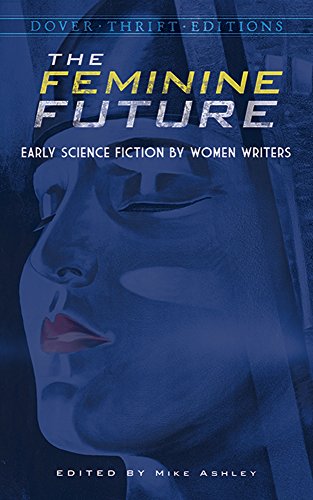
The Feminine Future: Early Science Fiction by Women Writers (Dover Thrift Editions)From Dover Publications

Download Ebook PDF The Feminine Future: Early Science Fiction by Women Writers (Dover Thrift Editions)From Dover Publications
"In addition to drawing attention to these overlooked female sci-fi authors, The Feminine Future is valuable for the perspective it provides on a period of transition for the genre." — Los Angeles Review of BooksFeaturing hard-to-find short stories published between 1873 and 1930, this original anthology spotlights a variety of important sci-fi pioneers, including Ethel Watts Mumford, Edith Nesbit, and Clare Winger Harris. Imaginative scenarios include a feminist society in another dimension, the east/west division of the United States with men and women on opposite sides, a man who converts himself into a cyborg, a drug that confers superhuman qualities, and many other curious situations.Editor Mike Ashley provides an informative introduction to the stories. Highlights include "When Time Turned" (1901), which centers on a grieving widower who contrives to relive his life backwards; "The Painter of Dead Women" (1910), the tale of a woman in thrall to a Svengali-like character who promises to preserve her beauty forever; "The Automaton Ear" (1876), in which an inventor struggles to create a machine to detect sounds from the distant past; "Ely's Automatic Housemaid" (1899), a lighthearted fable concerning a robot housemaid; and ten other captivating tales."Glad that Mike Ashley and Dover Publications have put together early science fiction by women authors. Great resource for classes!" — University of Maine at Machias
The Feminine Future: Early Science Fiction by Women Writers (Dover Thrift Editions)From Dover Publications- Amazon Sales Rank: #670287 in Books
- Published on: 2015-03-18
- Released on: 2015-02-18
- Original language: English
- Number of items: 1
- Dimensions: 7.80" h x .90" w x 5.00" l, .0 pounds
- Binding: Paperback
- 240 pages
From the Back Cover
Featuring hard-to-find short stories published between 1873 and 1930, this original anthology spotlights a variety of important sci-fi pioneers, including Ethel Watts Mumford, Edith Nesbit, and Clare Winger Harris. Imaginative scenarios include a feminist society in another dimension, the east/west division of the United States with men and women on opposite sides, a man who converts himself into a cyborg, a drug that confers superhuman qualities, and many other curious situations.Editor Mike Ashley provides an informative introduction to the stories. Highlights include "When Time Turned" (1901), which centers on a grieving widower who contrives to relive his life backwards; "The Painter of Dead Women" (1910), the tale of a woman in thrall to a Svengali-like character who promises to preserve her beauty forever; "The Automaton Ear" (1876), in which an inventor struggles to create a machine to detect sounds from the distant past; "Ely's Automatic Housemaid" (1899), a lighthearted fable concerning a robot housemaid; and ten other captivating tales.Dover (2015) original publication.See every Dover book in print atwww.doverpublications.com
About the Author British bibliographer, author, and editor Mike Ashley is a well-known anthologist and a recipient of the Mystery Writers of America's prestigious Edgar Award.

Where to Download The Feminine Future: Early Science Fiction by Women Writers (Dover Thrift Editions)From Dover Publications
Most helpful customer reviews
4 of 4 people found the following review helpful. Groundbreaking genre material for more than just feminists By Han Jie Regardless of preferred genre, most readers know the names Jules Verne, H.G. Wells, Robert Louis Stevenson, and H. Rider Haggard. On the strength of Jekyll and Hyde, Captain Nemo, the lost worlds of Africa, and Martians attacking Earth, they are considered pioneers, and by default, stanchions of science fiction and fantasy of the late 19th century. And all are men. Who were the women writing speculative fiction at the time? Unless the reader is a connoisseur of 19th and early 20th century genre, their answer is probably like mine: don’t know even if there were women writing spec fic. Having just finished editor Mike Ashley’s The Feminine Future: Early Science Fiction by Women Writers (2015, Dover Publications), I have been educated: there were women writing in that period, and not just writing, but producing stories of similar, groundbreaking quality as Verne, Wells, Stevenson, Haggard, and the rest.The Feminine Future anthologizes fourteen short stories published between 1876 and 1930 by women writers. Having read this byline, my initial concern was that Ashley had little material to work with, and therefore selected stories with only the thinnest of connections to sf. My concerns were very misplaced. The stories selected are undeniably genre. The speculative elements not minor or incidental, they occupy fundamental positions or are the foundations upon which the stories are built. Whether it be robots or alternate history, shifts in time or social experiments, each possesses a recognizable trope or element still in use today, including some that are arguably their first appearance in print.Expected given the era, several of the stories examine the potential negative effect of technology. Supposing we could build a machine that could read thoughts. Would it be beneficial or not?”, such is Ashley’s intro to “Those Fatal Filaments” by Mabel Ernestine Abbot. A quirky “electrician” testing the device on his wife, he learns things he’d rather not. It is every little boys dream to be able to walk through walls, and in “The Ray of Displacement”, Harrier Prescott Spofford brings the idea to life. Using Y-rays, a scientist is able to achieve not only invisibility, but also permeability, the subject’s cells able to pass through solids. Earliest published in the anthology, “The Automaton Ear” (1873) by Florence McLandburgh is about a man who is determined to construct the ultimate listening device. It’s the price he pays for creating such a thing, however, in which the real story exists.Positively divisive for the time, a handful of the stories invert or reverse gender roles in intriguing fashion. The longest piece in the anthology, “Via the Hewiit Ray” by M.F. Rupert opens on a letter from a scientist to his daughter Lucille. Telling the young woman he will soon transfer himself to another dimension, he also instructs her where she can find his laboratory notes on the light-wave machine that will send him there. Getting to know the ins and outs of the machine, it isn’t long before Lucille (Colt .45 and cigarettes in hand) finds herself in another dimension—one ruled by supremely civilized women. Extra-dimensional adventure with sharp gender overtones, it’s a fascinating read when taking into account the social context of when it was published. But perhaps more fascinating is the manner in which it puts to shame such modern efforts as Kameron Hurley’s The Mirror Empire. One would think the idea would have evolved to be more complex, not less. “Friend Island” by Francis Stevens is framed by a women-ruled world, but is about a grizzled bartender, the shipwreck she once was part of, and the strange island she washed onto. “A Divided Republic—An Allegory of the Future” by Lillie Deveraux Blake answers the question: what if women abandoned men and started their own state. At first, most of the men pretended that they were glad. “We can go to the club whenever we like,” said a certain married man. “And no one will fault us if we drop into a saloon,” added another. “Or say that tobacco is nasty stuff,” suggested a third.A story to be read in the context of its era—a time when women’s right to vote was not yet a reality, the humor takes on sharply satirical bite.Karol Capek is given credit for bringing the term ‘robot’ into English idiom in his 1920 theater production R.U.R. But in The Feminine Future, as early as 1897 we see evidence of anthropomorphized machines: before there were robots there was “Ely’s Automatic Housemaid” (1897) by Elizabeth W. Bellamy. Containing no Three Laws of the Electric Automatic Househould Beneficient Genius, it does contain charisma in bucketloads—“Papa, you better come, quick! It’s a-tearin’ up these beds!” an actual quote. About two B.G.s purchased to help clean a family’s home, it engenders a spot of fun (I kept thinking of Tom & Jerry). One of, if not the first cyborg story, “The Artifical Man” by Clare Winger Harris possesses a main character whose quest, after a freak football accident, is summed by:“I shall find out yet by how slender a thread body and soul can hang together.” Believing in corporeal perfection, he sets out to fully mechanize himself—a story that incidentally forms a nice precursor/left bookend to Philip K. Dick’s “The Electric Ant”.From the known (Astounding and Harper’s) to the unknown (Argosy and The Phrenological Journal), the anthology’s bibliography contains a fascinating list of source material. Before “The Curious Case of Benjamin Button” there was “When Time Turned” by Ethel Watts Mumford, published in a successful magazine of the time called The Black Cat. About a woman who goes to meet a friend for dinner, she is introduced to a most intriguing guest, and over the meal learns how he moves backwards through time. Each story opening with a brief bio, the reader is not only introduced to the story, but also the writers, their places in the field, and their relative accomplishments—very welcome indeed considering the high obscurity factor. Before “The Flying Teuton”, the reader learns about the successful career of Alice Brown, and then goes on to sample why. Not about not a ghost ship as the title might imply, rather a ghost fleet, it slowly twists into a state of fabulism the New Weird could embrace.Unlike today’s publishing environment, turn of the 19th century writers had to have their technique down. “The Painter of Dead Women” by Edna W. Underwood is a superbly written story of a woman who is taken to a ball by her husband. But when entering the gaudy room, she finds herself in an entirely different world—one more of her mind than body. Superman almost half a century before the Man of Steel came to exist in comics, “The Third Drug” by Edith Nesbitt is likewise very well written. About a man attacked on a dark Parisian street, he finds refuge at the nearby home of a doctor but quickly learns that the locked door keeping his would-be assailants on the street also prevents him from escaping. Offered a potion like no other, the assailants, however, become a minor concern.In the end, The Feminine Future is an amazing collection of stories. Not necessarily in the every-selection-blows-your-mind sense (though there are several high quality stories), rather in the gender/historical perspective it offers. It is as esoteric as sci-fi gets, in fact. Verne, Wells, and Stevenson no flukes, they were part of a wider community which included women writers producing stories just as quality, but who have been swept under the rug in the intervening time. Ashley is thus doing the community a wonderful service by pulling back the rug. Absolutely fascinating to read a story about a robot from the 19th century perspective, this anthology is not just for feminists or the p.c. crowd. It can be enjoyed by the whole spectrum of sf readers, and comes highly recommended.Published between 1876 and 1930, the following are the fourteen stories collected in The Feminine Future:“When Time Turned” by Ethel Watts Mumford“The Painter of Dead Women” by Edna W. Underwood“The Automaton Ear” by Florence McLandburgh“Ely’s Automatic Housemaid” by Elizabeth W. Bellamy“The Ray of Displacement” by Harrier Prescott Spofford“Those Fatal Filaments” by Mabel Ernestine Abbot“The Third Drug” by Edith Nesbitt“A Divided Republic—An Allegory of the Future” by Lillie Deveraux Blake“Via the Hewiit Ray” by M.F. Rupert“The Great Beast of Kafue” by Clotilde Graves“Friend Island” by Francis Stevens“The Artifical Man” by Clare Winger Harris“Creatures of the Light” by Sophie Wenzel Ellis“The Flying Teuton” by Alice Brown
1 of 1 people found the following review helpful. A fascinating overview of a neglected part of science fiction history By Chris Mike Ashley’s had an impressive career in science fiction as an editor and anthologist, from writing the four-volume History of the Science Fiction Magazine in the 1970s to editing the Mammoth Book of anthology series today. It seems he and I share some of the same values based on his introduction; he puts forth two popular genre misconceptions that this volume hopes to correct. First, that science fiction is a genre of just fanciful adventure stories, with its bug-eyed monsters and super-scientists jaunting across space and time. And second, that women writing science fiction is a newer development. Indeed, if you judge science fiction by the average “best-of” list and SF reader’s expectations, Ursula Le Guin was one of the first women to write in the genre. The Feminine Future collects fourteen science fiction stories by women writers, all of them written before the term “science fiction” was coined—even predating Gernsback’s ye olde “scientifiction.” These stories fall across the era of proto-SF, from contemporaries to Verne’s and Wells’ scientific romances all the way to early pulp SF tales in the ’20s and ’30s.The stories in this volume deal with the same themes that early science fiction would investigate over and over again: many of them follow the same pattern of “introduce a creative scientific idea and examine its effects on society/its users.” The difference is most of these stories were written decades before Hugo Gernsback named it “scientifiction” and proved there was enough of a market for this type of material to support monthly pulp magazines. Other stories take even more inventive approaches, dealing with ideas and concepts that are still original and fresh today. Some reflect issues of their day, reacting to Woman’s Suffrage, or impacted by The Boer War or World War One. Mike Ashley should be commended for finding these gems which were overlooked for so long; that they include such a variety of themes and styles is impressive.As with all collections, this is a mixed bag, and not every story will appeal to every reader. That’s precisely why I like it: this book shows how diverse science fiction was even in its earlier days. It covers the breadth of the early genre from adventure stories (“Via the Hewitt Ray”), to stories that blend horror and science (“Painter of Dead Women,” “The Third Drug”), to feminist utopias (“Divided Republic” and “Hewitt Ray”) or wild invention stories (“Automaton Ear,” “Automatic Housemaid,” “Fatal Filaments,” etc). Some of the stories are similar in theme or feel, but all of them are unique, different takes on the same concept of scientific invention and discovery changing the world. In some cases it’s for the better, in others for the worse, and in a few it’s good old fashioned comedy. My favorites lean towards adventure and the macabre, and include “The Great Beast of Kafue,” “Via The Hewitt Ray,” “Friend Island,” “The Painter of Dead Women,” “Ely’s Automatic Housemaid,” and “The Third Drug.”Readers not as familiar with pre-modernist literature may be put off by some of the artistic preferences of the age, like the awkward framing device in “When Time Turned,” or the distant and passive prose in “A Divided Republic.” I cut my teeth reading Wells, Verne, and Haggard, and still found some of the stories a bit dry and plodding for my taste. And the individual pieces have not always withstood the passage of time. But for anyone with a serious interest in science fiction’s history and origins, and those readers fascinated by genre gender studies, this slim volume fills an important gap in SF’s history. (What’s worse is that many readers remain unaware such a void exists.) It addresses shortcomings in perception and misconception that the average reader may have regarding early SF and the women who wrote it. The Feminine Future amounts to more than the sum of its parts: it’s a piece of science fiction history that is oft overlooked by most fans, a rich sample from an esoteric and overlooked niche. And I give it a high recommendation because of that.
1 of 1 people found the following review helpful. Fourteen Great Stories By M. Dowden We are being presented here with a wonderful and truly fascinating anthology of fourteen stories by female science fiction writers. The stories span the years from 1873 - 1930, and so this does show what people were thinking of most of the time in this genre at that period. I love pulp stories, which the majority of these are, although I am in to the whole pulp scene, and unlike some I am not that great a reader of sci-fi by itself.Mike Ashley gives us here an interesting introduction, and a short piece before each tale itself, which are worth reading. Some of the authors herein you will have heard of and some of these stories you may even have read before, but only probably a couple. As Ashley reminds us science fiction can take in a wide range of stories, so I expect some will debate the relevance of a couple of these to the genre, but regardless of that this is an enjoyable read.We do have a lot of serious tales here, which apart from technology and other dimensions also concern themselves with feminism and the rights of women, as well as creating a super person and the use of eugenics. There are a couple of comic tales here, one concerning the problems that could occur with automated servants, and another that looks at segregating men and women.I found this book to be a truly fascinating as well as an entertaining read and I know that I will come back to it time and again. This could even make a good choice for book groups as there is a lot to discuss here.I was kindly provided with a review copy of this by the publisher via NetGalley.
See all 6 customer reviews... The Feminine Future: Early Science Fiction by Women Writers (Dover Thrift Editions)From Dover PublicationsThe Feminine Future: Early Science Fiction by Women Writers (Dover Thrift Editions)From Dover Publications PDF
The Feminine Future: Early Science Fiction by Women Writers (Dover Thrift Editions)From Dover Publications iBooks
The Feminine Future: Early Science Fiction by Women Writers (Dover Thrift Editions)From Dover Publications ePub
The Feminine Future: Early Science Fiction by Women Writers (Dover Thrift Editions)From Dover Publications rtf
The Feminine Future: Early Science Fiction by Women Writers (Dover Thrift Editions)From Dover Publications AZW
The Feminine Future: Early Science Fiction by Women Writers (Dover Thrift Editions)From Dover Publications Kindle
Tidak ada komentar:
Posting Komentar