World War 1990: Operation Arctic Storm, by William Stroock
World War 1990: Operation Arctic Storm, By William Stroock. Someday, you will discover a brand-new experience and knowledge by investing more cash. However when? Do you assume that you should obtain those all demands when having significantly money? Why do not you aim to obtain something straightforward at first? That's something that will lead you to know even more about the globe, adventure, some locations, past history, enjoyment, as well as much more? It is your own time to continue reviewing routine. Among guides you could delight in now is World War 1990: Operation Arctic Storm, By William Stroock here.
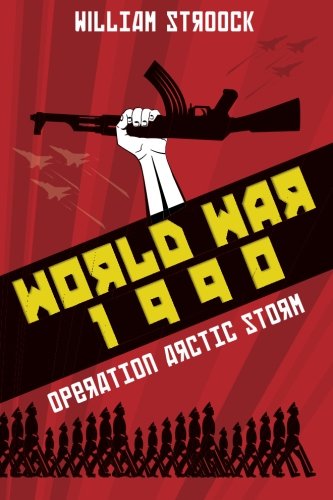
World War 1990: Operation Arctic Storm, by William Stroock

Download Ebook World War 1990: Operation Arctic Storm, by William Stroock
In a different 1990… The Soviet/Warsaw Pact offensive against NATO almost succeeded save for a last ditch defense by NATO forces in the epic Battle of the Weser River. But with the communist advance halted tough decisions lie ahead for NATO. Prime Minister Thatcher and Chancellor Kohl want to counterattack, while the Bush Administration worries about the effects of further war. As NATO deliberates, the United States and Royal Navies gather in the North Sea for a massive offensive against Soviet occupied Norway. In the Soviet Union the Politburo is split between the hawks and doves, and contemplates the unthinkable nuclear option. Its two minutes to midnight in Operation Arctic Storm.
World War 1990: Operation Arctic Storm, by William Stroock- Amazon Sales Rank: #137960 in Books
- Published on: 2015-03-19
- Original language: English
- Number of items: 1
- Dimensions: 9.00" h x .57" w x 6.00" l, .75 pounds
- Binding: Paperback
- 250 pages
From the Author This novel is about the war that never happened, the Third World War, and it's the novel I have always wanted to write. Born in 1973, I was a child of the Cold War. The threat of nuclear war was always below the surface of daily life, a vague possibility a child might have wondered about when he went to bed, just as Roman children might have wondered about Hannibal or British children might have wondered about Napoleon. There were a few important novels about World War III, and many readers no doubt are familiar with them. The first is Tom Clancy's Red Storm Rising. Over 700 pages long, this dyslexic 14 year old read it in one dreary, February winter break. I was hooked. In the 1980s one could also read General Sir John Hackett's Third World War. While Clancy's was a spellbinding novel, a techno-thriller the genre came to be called, Hackett wrote his tale of World War III from the perspective of historians a few years after the conflict. Of course, by the time I was discovering the possibility of the Third World War, the actual Cold War was thawing out, and then Saddam Hussein stupidly invaded Kuwait. I was 17 years old, and because I played tabletop war games and had read a few Tom Clancy novels, I knew more about what was happening than journalists with advanced degrees and decades of experience, but no understanding of military affairs whatsoever. So in the summer of 1990, the United States military armed with the latest high tech weaponry, new doctrine, and a generation of leaders eager to use both in an epic battle of maneuver, was sent to the Middle East. In four days of war, the armed forces of the United States and her allies made mincemeat of the larger, battle tested Iraqi Army. Here were the high tech weapons built for Armageddon on the European battlefield; smart bombs, stealth fighters, M-1 tanks, cruise missiles used to deadly effect by remorseless killing technocrats like Dick Cheney and Colin Powell, and their battlefield commander 'Stormin' Norman' Schwarzkopf. The Iraqis never stood a chance. From there the best ever trained, motivated, equipped and led American military faded into history. A quarter century after the end of the Cold War the massive 28 Division United States Army and 600 ship U.S. Navy are gone, no longer necessary, really.Writing this book was like coming home again. In their World War III novels, General Hackett and Tom Clancy made informed guesses which were generally right. Hackett's book, written in 1978 was a warning to NATO and the west, then reeling from communist advances in the 1960s and 1970s. Frankly, NATO would have lost a war fought in the 1970s. By the time Tom Clancy published Red Storm Rising in 1986 that calculus had changed. The Untied States was deploying the latest weapons, of which the nearly invincible M-1 tank was the most important, and training under the doctrine of maneuver warfare known as AirLand Battle 2000. Clancy understood the technological edge NATO had acquired. Also, he had intensely studied the Soviet Armed Forces and was not impressed. In Red Storm Rising Clancy portrays a Soviet Army that was cumbersome, top-heavy and slow to adapt. Its only advantage lay in numbers. Clancy, I think, was right about the Soviet Army. Researching this book was both fun and interesting. In doing so I took two tracks. First, I read Cold War era books about the world militaries at the time. For the United States military I used the various non-fiction works of Tom Clancy, Submarine, Armored Cav, Carrier, and especially Into The Storm, which also gave me background on many of the personalities involved. Speaking of personality, Bob Woodward's The Commanders was a sensation at the time of its release in 1991 and indispensable to me. I am well aware of the weakness of Woodward's work and agree with most of his critics. It is all too easy for one to discern who Woodward's sources are as he rewards them in his books. However, many of the players in The Commanders came to the public eye again in the 2000s, and I think Woodward's sketches of these men stand the test of time. To anyone who was paying attention, George Bush the Elder came off as a wishy-washy wimp, an unfair characterization of a man who was shot down in the Pacific. Still, 1992 was my first presidential and I say without regret that I voted against him. Woodward shows a tough, decisive leader in charge of his government. I have tried to present a bit of the personality of the first President Bush, a man whose reputation has greatly improved in recent years; an assessment with which I agree. As readers will see, I wanted World War 1990 to have a strong British element. To get a feel for the British Army I used Antony Beevor's Inside the British Army, a detailed study of the BAOR and other forces. For the SAS I read Andy McNab's interesting tale of operations in the Gulf War, Bravo-Two Zero. Keeping with the Gulf War theme, General Sir Peter de la Billiere wrote an excellent account of his time in Desert Storm with Schwarzkopf in Storm Command. On the tactical level, Major General Patrick Cordingley gives a good account of his 7 Armoured Brigade, (the famed Desert Rats) with In the Eye of the Storm. Switching to the Royal Navy, I used Admiral Sandy Woodward's account of his command in the Falklands One Hundred Days. Tom Clancy covers British submarine forces in Submarine. I also used Captain Richard Woodman's Cold War Command, his own account of serving aboard and skippering Royal Navy subs during the Cold War. To understand submarine warfare a little better, and the technical issues involved, I consulted The Third Battle: Innovation in the U.S. Navy's Silent Cold War Struggle with Soviet Submarines by Owen R. Cote, Jr. For the opposing forces, I used a trio of old coffee table books that I bought around 1990 and never threw out. These are Salamander Books' The World's Armies, The World's Navies, and The World's Air Forces. They contain detailed sketches on the armed forces of the world at that time, all of them, with orders of battles where available. Another important book was NATO-Warsaw Pact Force Mobilization, edited by Jeffrey Simon. This was a massive academic work published by the National Defense University in 1988 and it goes into extraordinary detail about NATO and Soviet armed forces and the issues both faced. To understand the Soviet Union at the time I read Michael Dobb's excellent Down with Big Brother, which covers not only the rise of Gorbachev and the fall of the Soviet Union, but the unrest in Poland. Another useful book was David R. Marples The Collapse of the Soviet Union 1985-1991. Describing the inner workings of the Politburo is Pavel Ligachev's Inside Gorbachev's Kremlin. Ligachev's memoirs are just awful. They are a recitation of meetings, plenums, committee assignments and conferences. In spite of their awfulness, Ligachev's memoirs tell us much about the Politburo and the Soviet Union. The Soviet High Command: 1967-1989 by Dale R. Herspring is an interesting book that describes the major personalities in the Soviet military, especially those responsible for the massive Brezhnev era arms buildup. William E. Odom's The Collapse of the Soviet Military describes the structure and doctrine of that nation's armed forces and everything that was wrong with them. In A Cardboard Castle, Vojtech Mastny and Malcolm Byrne do the same for the Warsaw Pact.

Where to Download World War 1990: Operation Arctic Storm, by William Stroock
Most helpful customer reviews
9 of 10 people found the following review helpful. Not ready for prime time By M. J Bauer This is an intriguing idea, what if World War III was fought about 1990? Interesting idea but the book missed the mark in some key areas.Characters are at best one dimensional. We never get an idea of who these people are. Yes, we know many from the history books but why they do what they do? What are the reasons behind their actions?The scale is limited, we read about WW II but in fact the scale is limited and the battles are described in a very superficial way. The author doesn't seem to be very knowledgeable about infantry tactics. For example (not a spoiler) a Soviet parachute force is overcome by civilians. Yes it is possible, but the Soviet infantry do not use any training or discipline, really zero. They don't know about OP's, fields of fire, attacking ambushes, etc.Naval and air battles also are lightly touched on, planes fly, ships sail, some are downed, sunk, etcI started out giving it 3 stars but as I wrote this I realized 2 are sufficient. Again, an intriguing idea, but in need of a good editor or being set aside for a couple of weeks and then revisited by the author. The author would be interesting to talk to and has some great ideas but since we only have the book to go on I am afraid it is a miss
8 of 10 people found the following review helpful. Everyone Who Purchased This Book Deserves A Refund And An Apology From The Author By Mike C I feel horrible for wasting a star. This book truly deserves none. Yes, I mean it. World War 1990 was honestly that bad.The author is a history professor at Raritan Valley Community College. I know this school quite well, having took a number of summer courses there as an undergrad. I met many excellent professors and instructors there, some of whom are still teaching there today. Two men who had quite positive influences on me were both history professors. So, when I found out that the author of this book is an adjunct history professor at RVCC, I decided to give his book a try. I'm almost sorry that I did. If William Stroock teaches as badly as he writes novels, the students at RVCC are in serious trouble.Before I begin the review, I would like to say that I'm not simply a casual fan of this genre. I have real world experience in both the military and political sides of the equation. Along with this, I also hold a fairly respectable academic pedigree. I understand geo-politics and military matters in both the practical and theoretical senses. What this means is that I was expecting a significant degree of realism, believable plot and seamless flow in World War 1990.I found none of these things. Instead, I discovered a heaping pile of disappointment in the pages of World War 1990. It was so bad that my Kindle still refuses to accept new books. World War 1990 was so traumatic that it caused an electronic app to shed tears of sorrow and fall into a deep depression. Here's why it was so bad......The internet is a wonderful thing and has advanced our world in countless ways. On the flip side, the internet has also opened an avenue for unpolished, mediocre (using the term very lightly) authors like Stroock to pedal their half-baked manuscripts to an audience and fan base that really cannot discern good writing from slop. Alternative history is all the rage now. Believable military techno-thrillers are also still quite popular. Strook probably figured he could write a novel about how World War III might have played out in 1990 and it would be guaranteed money in the bank. Well, he thought wrong.Let's begin with the plot. The novel starts in the middle of World War 3. It's 1990 and the Warsaw Pact invasion of West Germany has been stopped. While the Soviet Union licks its wounds, fighting erupts in other theaters. That is all well and good. What is not acceptable is the scattered and senseless background information the reader is given. We learn the 'what' and 'how' but Strook inconveniently forgets to include the 'why.' Back to the plot....after the Soviet drive in Europe is blunted, they decide to open up a new theater of operations in Alaska. Paratroopers are dropped into Nome to secure the town's port and airfield. Somehow, the locals wind up defeating a crack unit of Soviet airborne troopers. It's not realistic, and borderline Alien Space Bats. The characters are not very believable and neither is the outcome. In some scenes, he gives detailed descriptions of some Soviet paratroopers playing Nintendo games. Stroock seems to have more knowledge of Tecmo Bowl than of Soviet airborne units and operations! The point of view then shifts to the Norwegian Sea where NATO is planning an operation to retake parts of Norway under Soviet occupation. Strook's writing really falls apart here. His lack of military knowledge becomes glaringly apparent in the passages describing the trials and tribulations of the USS.Stirling, a fictional Spruance class destroyer. He is not very well versed on Spruance class destroyers, their capabilities or US naval terminology and tactics of the time period. For example, the captain of the Stirling and the XO are conveniently always on the bridge during battle scenes. US ship commanders fight the battle from CIC. When sailors and officers are talking about their sister ships, they say something along the lines of "Here comes the New Jersey" or "We're coming parallel to the Eisenhower." In this book, Strook has them saying "Here comes USS New Jersey." and such. It doesn't feel right, mainly because it is not.The characters are all cardboard and the dialogue not realistic at all. The politicians all come across in their predictable, stereotypical manners. There's little presented to allow the reader to compare them to how they acted or came across in real life. The military characters are just sad. It's quite obvious early on that Stroock has never served in the military, nor has he researched the subject very well.The book is filled with typos and bad grammar. I can excuse bad grammar, however, there is no excuse for misspellings and such in this day and age. His editors must have been some of his students. The real horror is found in mistakes so obvious that they will make you cringe or groan. Like when he describes a "Mig-27 Flanker." If you're writing a military novel, there's no excuse for making a basic foul up like that.I can go on about this book and give more details, but it wouldn't be beneficial to the readers or the author. I may pick up another one of his later works just to see if Stroock has improved his craft. Or, perhaps I'll see if he is still teaching at RVCC and sign up for one of his classes. If I can find the time I'd love to audit a history class taught by this author. Perhaps he can teach me something about history or politics. Something useful that I failed to learn at Georgetown (MSFS) or Princeton (MPA, Ph.D in Politics) Then again, maybe not.
4 of 5 people found the following review helpful. A well written and great read. By Andre E. King An extremely well told yarn of the war that never was... but still might be. Stroock has written the perfect companion book to other in the genre like "Red Storm Rising", "Team Yankee" and "The Third World War: August 1985". The prose is straight forward and easy to understand. Much like the men who fight the conflict in the book. I like the way he uses real leaders of the time rather than creating loosely fictionalized versions of them. Having known one of these men I can tell you he pretty well nailed down how he would behave. The story moves lightning fast and never bogs down in too much detail or endless descriptions of weaponry and battles and instead gives us briefs of immediate aftermaths of major engagements in short messages or after action reports. Though this is welcome to those of us that know all about the hardware for the casual or first time reader of the genre more description is needed. Most first timers will not have a clue as to what a Backfire is.Some of his facts are probably off. The sinking of a U.S. carrier for instance would probably not happen (simply because of the way the ships are designed and compartmentalized now) unless it was hit by a nuke but the point is made anyhow.I blasted through this book in one day and two sittings. You never could anticipate what was going to happen next and the action moved swiftly from one group of characters and fronts to the next. Never a dull moment here just a couple of annoying loose ends. (What happened up in Alaska?) The only thing I hated was the fact that it ended. I can't wait to read the next installment.
See all 39 customer reviews... World War 1990: Operation Arctic Storm, by William StroockWorld War 1990: Operation Arctic Storm, by William Stroock PDF
World War 1990: Operation Arctic Storm, by William Stroock iBooks
World War 1990: Operation Arctic Storm, by William Stroock ePub
World War 1990: Operation Arctic Storm, by William Stroock rtf
World War 1990: Operation Arctic Storm, by William Stroock AZW
World War 1990: Operation Arctic Storm, by William Stroock Kindle

Tidak ada komentar:
Posting Komentar