Unity Virtual Reality Projects, by Jonathan Linowes
As understood, book Unity Virtual Reality Projects, By Jonathan Linowes is popular as the home window to open the world, the life, as well as extra thing. This is just what individuals currently need a lot. Even there are many individuals that do not such as reading; it can be a selection as reference. When you actually need the methods to produce the next motivations, book Unity Virtual Reality Projects, By Jonathan Linowes will actually lead you to the method. Moreover this Unity Virtual Reality Projects, By Jonathan Linowes, you will certainly have no remorse to get it.
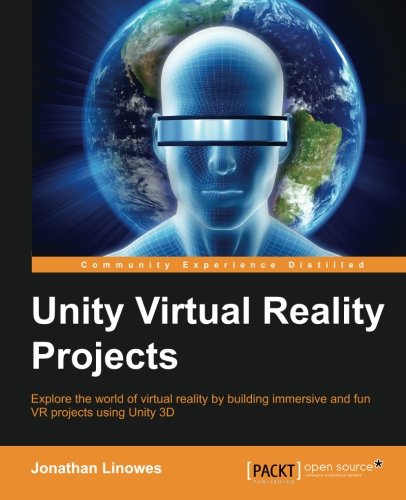
Unity Virtual Reality Projects, by Jonathan Linowes

Download Ebook PDF Online Unity Virtual Reality Projects, by Jonathan Linowes
Explore the world of Virtual Reality by building immersive and fun VR projects using Unity 3D
About This Book
- Learn the basic principles of virtual reality applications and get to know how they differ from games and desktop apps
- Build various types of VR experiences, including diorama, first-person characters, riding on rails, 360 degree projections, and social VR
- A project-based guide that teaches you to use Unity to develop VR applications, which can be experienced with devices such as the Oculus Rift or Google Cardboard
Who This Book Is For
If you're a non-programmer unfamiliar with 3D computer graphics, or experienced in both but new to virtual reality, and are interested in building your own VR games or applications then this book is for you. Any experience in Unity is an advantage.
What You Will Learn
- Create 3D scenes with Unity and Blender while learning about world space and scale
- Build and run VR applications for consumer headsets including Oculus Rift and Google Cardboard
- Build interactive environments with physics, gravity, animations, and lighting using the Unity engine
- Experiment with various user interface (UI) techniques that you can use in your VR applications
- Implement the first-person and third-person experiences that use only head motion gestures for input
- Create animated walkthroughs, use 360-degree media, and build multi-user social VR experiences
- Learn about the technology and psychology of VR including rendering, performance and VR motion sickness
- Gain introductory and advanced experience in Unity programming with the C# language
In Detail
What is consumer “virtual reality”? Wearing a head-mounted display you view stereoscopic 3D scenes. You can look around by moving your head, and walk around using hand controls or motion sensors. You are engaged in a fully immersive experience. On the other hand, Unity is a powerful game development engine that provides a rich set of features such as visual lighting, materials, physics, audio, special effects, and animation for creating 2D and 3D games. Unity 5 has become the leading platform for building virtual reality games, applications and experiences for this new generation of consumer VR devices.
Using a practical and project-based approach, this book will educate you about the specifics of virtual reality development in Unity.
You will learn how to use Unity to develop VR applications which can be experienced with devices such as the Oculus Rift or Google Cardboard. We will then learn how to engage with virtual worlds from a third person and first person character point of view. Furthermore, you will explore the technical considerations especially important and possibly unique to VR. The projects in the book will demonstrate how to build a variety of VR experiences. You will be diving into the Unity 3D game engine via the interactive Unity Editor as well as C-Sharp programming.
By the end of the book, you will be equipped to develop rich, interactive virtual reality experiences using Unity.
So, let's get to it!
Style and approach
This book takes a practical, project-based approach to teach specifics of virtual reality development in Unity. Using a reader-friendly approach, this book will not only provide detailed step-by-step instructions but also discuss the broader context and applications covered within.
Unity Virtual Reality Projects, by Jonathan Linowes- Amazon Sales Rank: #94735 in Books
- Published on: 2015-09
- Released on: 2015-09-01
- Original language: English
- Number of items: 1
- Dimensions: 9.25" h x .65" w x 7.50" l, 1.09 pounds
- Binding: Paperback
- 286 pages
About the Author
Jonathan Linowes
Jonathan Linowes is the owner of Parkerhill Reality Labs, a start-up VR/AR consultancy firm. He is a veritable VR and 3D graphics enthusiast, full-stack web developer, software engineer, successful entrepreneur, and teacher. He has a fine arts degree from Syracuse University and a master's degree from the MIT Media Lab. He has founded several successful start-ups and held technical leadership positions at major corporations, including Autodesk Inc.

Where to Download Unity Virtual Reality Projects, by Jonathan Linowes
Most helpful customer reviews
2 of 2 people found the following review helpful. Nicely Done By Rob I enjoyed this book quite a bit. It was far more informative than I thought it would be. I have both the Oculus Rift DK2 and the Google Cardboard device, and I could follow the examples pretty closely. I have a bit more experience with Unity than this book requires. So I was able to modify some of his logic and do more interesting things. I created a demo application that has a trampoline, an elevator, an infographic of the history of the world, a 360 degree panorama and a photo-sphere. He does a good job explaining the basics of HUD design, multiplayer networking considerations, and social networking. And he provides several resources where one can go to obtain more information.
6 of 6 people found the following review helpful. A real fantastic book written in a style to really get you going in all things VR with Unity. More please. By Mr. S. Jackson this book focuses solely on Virtual Reality (VR) over Augmented Reality (AR) solutions. In its pages you’ll discover how VR apps and games differ from their desktop counterparts and what really goes in to making them (especially focusing on scale!, very important), walks you through several different types of VR solutions like Diorama’s, First person controllers, riding on rails (like a rollercoaster), 360 projections (you are IN the painting) and social VR. You’ll even delve in to several VR implementations inside Unity 5 such as the Oculus rift and (for those of you without a few hundred £ or $ to spare) Google cardboard. Virtually everything for everyone As expected, the beginning chapter talks thoroughly about what VR is and what it isn’t, together with an in-depth comparison between VR and AR. It also goes through all the different VR style experiences and how these apply to both apps and games. Finally it covers some of the technical skills you’ll need (yes you do need Math!) to build effective VR solutions. Objects and scale A no-nonsense intro to Unity (practically just one page, which I like because too many titles waffle on about “installing unity”) followed by a deep dive into creating your first VR scene, before finishing off with a high level walkthrough creating a basic asset in Blender (a free 3D modelling tool) and importing it in to Unity, keeping an eye on the all-important scale (I did say scale is important!) VR Build and run So you have your VR scene, now what? Time to get it on a device, whatever you have to hand. This chapter does a nice big overview of the many options of building your VR solution through Unity, focusing eventually on building for the Oculus Rift and Google Cardboard (if you are buying this book, you should have some spare change for a cardboard device at least, especially since the Vis-VR is only £2.50, oh and you’ll need a mobile device as well Open-mouthed smile) Gaze-based control In this chapter you’ll implement a gaze based control system (point and click for your eyes), together with some third person basic AI and nav meshes. World space UI Time to start messing with the new UI system and building a World Space UI for your VR viewer to see and use in your VR scenes. Not quite the full Iron Man overlay but close. It does cover however, a basic Visor, reticule, windshield hud, info bubbles and much more. First-person character Switching gear, it’s time to get behind the eyes of the player and allow them to “play as themselves”. Walking through all the tips and tricks necessary to not have your player vomiting all over the floor and ripping off the goggles, it’s important to ensure your player has a good experience in your VR environment. Physics and the environment Taking the first-person view up a notch, the author adds a little physicality to the player’s experience, allowing them to jump and knock stuff over. Not quite the VOID experience (if you don’t click on that link, you are truly missing out!) but virtually close. Walk-throughs and rendering So far the player has been in control, but some experiences work best if they just sit back and relax, letting you guide them around a scene or view (getting out of a rollercoaster while it’s moving is not recommended, even in VR!). This chapter covers building a tour scene, putting some more blender content to work and making the best out of the scene, while keeping a firm eye on what you need to do to provide the best performance with the hardware you have at your disposal. Using all 360 degrees (I Hands down love the image that introduces this chapter Open-mouthed smile) With another slant on VR we enter the art world, or more poignantly, 3D imagery and photosphere’s. Taking a whole world scene for the user to view and explore, taking a flat image and wrapping it around the viewers head. Social VR Metaverse Akin to Neil Stephenson’s Snow Crash, the author breaks down those single player walls in a VR experience and explores what more than one person can do in the MetaVerse, building a VR chat room when multiple VR participants can enter a room and talk (like your everyday meetings but FUN).Pros / Cons and conclusionOverall, I’m very impressed with this title, both for its content and approach but also because the author writes and thinks like me Open-mouthed smile. There is a very clear intention to structure the content so that it is easily read and informs the reader at a clear pace. Also unlike the previous title, it covers a much more varied level of content and approaches to VR. As books go, it’s one of the best ones I’ve read recently (baring my own Smile with tongue out of course), certainly one to pick up if you want to get serious about VR.Pro’s Good fundamentals backed with practical examples You’ll get several projects with a great variety of approaches, just about everything you would need for VRCon’s For once I’m stumped. I simply have nothing bad to say on this title. Fantastic effort!
3 of 3 people found the following review helpful. This was an excellent book to work through By Mazzran This was an excellent book to work through. I have learned so much and am excited to try out some of the ideas on my own projects. I enjoyed it so much, that I am planning on working through the entire book again from page one. Well done to the author - I would recommend it to anyone interested in developing for virtual reality!
See all 11 customer reviews... Unity Virtual Reality Projects, by Jonathan LinowesUnity Virtual Reality Projects, by Jonathan Linowes PDF
Unity Virtual Reality Projects, by Jonathan Linowes iBooks
Unity Virtual Reality Projects, by Jonathan Linowes ePub
Unity Virtual Reality Projects, by Jonathan Linowes rtf
Unity Virtual Reality Projects, by Jonathan Linowes AZW
Unity Virtual Reality Projects, by Jonathan Linowes Kindle
Tidak ada komentar:
Posting Komentar