On the Duty of Civil Disobedience: Color Illustrated, Formatted for E-Readers (Unabridged Version), by Henry David Thoreau
After understanding this extremely easy method to check out and get this On The Duty Of Civil Disobedience: Color Illustrated, Formatted For E-Readers (Unabridged Version), By Henry David Thoreau, why don't you tell to others regarding this way? You can inform others to see this internet site and also opt for browsing them favourite books On The Duty Of Civil Disobedience: Color Illustrated, Formatted For E-Readers (Unabridged Version), By Henry David Thoreau As known, below are bunches of lists that offer lots of sort of books to accumulate. Merely prepare few time as well as net links to obtain guides. You could really enjoy the life by checking out On The Duty Of Civil Disobedience: Color Illustrated, Formatted For E-Readers (Unabridged Version), By Henry David Thoreau in an extremely basic fashion.
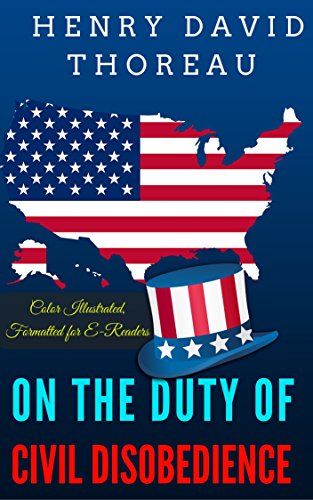
On the Duty of Civil Disobedience: Color Illustrated, Formatted for E-Readers (Unabridged Version), by Henry David Thoreau

Best Ebook PDF On the Duty of Civil Disobedience: Color Illustrated, Formatted for E-Readers (Unabridged Version), by Henry David Thoreau
How is this book unique?
Formatted for E-Readers, Unabridged & Original version. You will find it much more comfortable to read on your device/app. Easy on your eyes. Includes: 15 Colored Illustrations and Biography On the Duty of Civil Disobedience is an essay by American transcendentalist Henry David Thoreau that was first published in 1849. In it, Thoreau argues that individuals should not permit governments to overrule or atrophy their consciences, and that they have a duty to avoid allowing such acquiescence to enable the government to make them the agents of injustice. Thoreau was motivated in part by his disgust with slavery and the Mexican–American War. In 1848, Thoreau gave lectures at the Concord Lyceum entitled "The Rights and Duties of the Individual in relation to Government." This formed the basis for his essay, which was first published under the title Resistance to Civil Government in 1849 in an anthology called Æsthetic Papers. The latter title distinguished Thoreau's program from that of the "non-resistants" (anarcho-pacifists) who were expressing similar views. Resistance also served as part of Thoreau's metaphor comparing the government to a machine: when the machine was producing injustice, it was the duty of conscientious citizens to be "a counter friction" (i.e., a resistance) "to stop the machine." In 1866, four years after Thoreau's death, the essay was reprinted in a collection of Thoreau's work (A Yankee in Canada, with Anti-Slavery and Reform Papers) under the title Civil Disobedience. Today, the essay also appears under the title On the Duty of Civil Disobedience, perhaps to contrast it with William Paley's Of the Duty of Civil Obedience to which Thoreau was in part responding. For instance, the 1960 New American Library Signet Classics edition of Walden included a version with this title. On Civil Disobedience is another common title. The word civil has several definitions. The one that is intended in this case is "relating to citizens and their interrelations with one another or with the state", and so civil disobedience means "disobedience to the state". Sometimes people assume that civil in this case means "observing accepted social forms; polite" which would make civil disobedience something like polite, orderly disobedience. Although this is an acceptable dictionary definition of the word civil, it is not what is intended here. This misinterpretation is one reason the essay is sometimes considered to be an argument for pacifism or for exclusively nonviolent resistance. For instance, Mahatma Gandhi used this interpretation to suggest an equivalence between Thoreau's civil disobedience and his own satyagraha. On the Duty of Civil Disobedience: Color Illustrated, Formatted for E-Readers (Unabridged Version), by Henry David Thoreau- Amazon Sales Rank: #1500105 in eBooks
- Published on: 2015-09-06
- Released on: 2015-09-06
- Format: Kindle eBook
From the Back Cover Henry David Thoreau's Civil Disobedience was originally published in 1849 as Resistance to Civil Government. Thoreau wrote this classic essay to advocate public resistance to the laws and acts of government that he considered unjust. The practical application of Civil Disobedience was largely ignored until the twentieth century when, at different times, Modanda Ghandi, Martin Luther King, Jr. and anti-Vietnam War activists applied Thoreau's principles.
About the Author Henry David Thoreau was an American author, poet, and philosopher, who is best known for his works Waldena treatise about living in concert with the natural worldand Civil Disobedience, in which he espoused the need to morally resist the actions of an unjust state. Thoreau s work heavily reflects the ideologies of the American transcendentalists, and he has long been considered a leading figure in the movement along with Ralph Waldo Emerson, Bronson Alcott, and, at first, Nathaniel Hawthorne (who changed his views later in life). In addition to his writing, which totaled more than twenty volumes, Thoreau was an active abolitionist, and lectured regularly against the Fugitive Slave Law. Thoreau died in 1862, and is buried along with Louisa May Alcott, Ellery Channing, and other notable Americans in Sleepy Hollow Cemetery in Concord, Massachusetts.

Where to Download On the Duty of Civil Disobedience: Color Illustrated, Formatted for E-Readers (Unabridged Version), by Henry David Thoreau
Most helpful customer reviews
137 of 141 people found the following review helpful. A masterpiece of individualism and the fight for justice. By Ragnarok Books Civil Disobedience is one of the most importance works of philosophy ever written. Like all great works of philosophy, it is as relevant today as it has ever been, as it transcends space and time. Don't let the abolitionist nature mislead you: this book is not merely about abolition and slavery. Rather, it is about Man Against the State, individuality, and Thoreau's philosophy of how one man can stand up to government and society, driven by his own convictions of right and wrong, as summarized by the timeless quote "Any man more right than his neighbors constitutes a majority of one already".Thoreau's main point is that the best - and many times, the only - method for fighting injustice is through passive disobedience. By refusing to cooperate with the machinery of injustice, the individual can become the friction that stops the machine. Active resistance is bound for failure, as the machine (the State, society, etc.) is too formidable for the individual to fight. But, by refusing to cooperate, justice can be achieved and injustice toppled.If you are looking for a marvelous primer on individuality and the fight for justice, start with this book.
53 of 54 people found the following review helpful. "It is not so desirable to cultivate a respect for the law, so much as for the right."-Henry David Thoreau By Medusa In "Civil Disobedience" Thoreau presents political theories in which he dissects democracy and the interaction between citizens and their government.Understandably, Thoreau was deeply concerned about injustices he witnessed during his life, such as enslavement of one sixth of the population and the invasion of Mexico by the United States.Thoreau does not oppose the institution of government; he believes that when a government becomes "abused and perverted", it ceases to represent the will of the people. When a government makes decisions that promulgate harm and injustice, it is the duty of its citizens to rebel and break those chains of injustices.Arguably, the strongest idea Thoreau presents, is the notion of individualism. Thoreau encourages skepticism of the government and rejects blind loyalty to it. Thoreau perceives citizens, who give blind loyalty to their government's decisions without questioning them, as participants in every injustice committed by that government. Whether this point of view is correct or not, it is worth debating, especially in view of the horrific injustices that are extant in today's world and the way the masses so easily accept them without considering the negative impact on others.
71 of 76 people found the following review helpful. Arise, Ye Overworked Americans! By Jeffrey Leach Henry David Thoreau (1817-1862) was an American philosopher, poet, and naturalist who moved in the same intellectual and social circles as Ralph Waldo Emerson. This Dover Thrift edition contains several important Thoreau tracts: Civil Disobedience, Slavery in Massachusetts, A Plea for Captain John Brown, Walking, and Life Without Principle. Thoreau also wrote the famous "Walden," and several other influential pieces shaped by his sense of environment and his unwavering belief in the power of the individual.In "Civil Disobedience," Thoreau discusses the role of the individual in society and government. Starting off with his famous statement, "That government is best which governs not at all," Thoreau waxes philosophic about the role of the United States government in the Mexican War and slavery. Thoreau argues that majorities in a democracy decide what the laws are because they are the strongest element in society. According to Thoreau, what is law is not necessarily right, and just because the majority decides an issue doesn't automatically make that issue palatable to a man's conscience. Individuals can, and sometimes should, oppose the majority, and they can be right even if they are in the minority. Ultimately, if laws are not reliable beacons of truth, one should appeal to one's conscience to decide what is right and wrong. However, merely deciding something is wrong is not enough if that decision is not followed by concrete action. Thoreau criticizes the voting process in this context, since anybody can vote for something. Without action following a decision, voting or supporting something is useless. This essay also contains Thoreau's account of his stay in jail for failure to pay a tax."A Plea for Captain John Brown" probably caused considerable controversy at the time of its writing. John Brown was the fire-breathing abolitionist who made the famous raid on Harper's Ferry in the 1850's. Brown eventually went to the gallows for his crimes while American citizens debated his actions. Most thought Brown a wacko, an extremely dangerous radical who threatened the social fabric of the country. Thoreau defends Brown in an essay both eloquent and naïve. This is really a panegyric to an unrealistic man who used questionable methods to attain his goal. When Thoreau refers to Brown as "an angel of light," it is necessary for the reader to remember Brown killed many people in cold blood."Walking" is the centerpiece of this collection of essays. Thoreau starts his discussion by musing on the wonders of walking in the country (sans terre, or "sauntering"), and ends up discussing nature, the movements of mankind, work, and freedom. Thoreau feels we gave up something very special when we locked ourselves in our shops and devoted our days to long hours of work. Get out! Enjoy life! Admire the trees, a sunset, and the birds! Don't give up your freedom for a wage and dull toil! These are the things Thoreau urges upon us in this essay, and he certainly has a point. This is an amazing piece of writing because it is probably more relevant today than in Thoreau's time. At least in those days vast expanses of nature still existed. Today, we must climb into our little boxes with wheels and drive for miles before we see a small forest or some mountains, while elbowing our way through all the others doing the same thing. "Walking" is a beautiful testament to a bucolic life.I find Thoreau's writings vastly superior to anything Emerson wrote. Thoreau is more accessible, cares more about concrete issues, and seems like a nicer person. Thoreau comes across as the type of guy you could shoot the breeze with for an hour or so, whereas Emerson seems aloof and esoteric. Thoreau as a person is from an era long dead, but his words continue to resonate deeply in our souls. I think I'll go take a walk.
See all 254 customer reviews... On the Duty of Civil Disobedience: Color Illustrated, Formatted for E-Readers (Unabridged Version), by Henry David ThoreauOn the Duty of Civil Disobedience: Color Illustrated, Formatted for E-Readers (Unabridged Version), by Henry David Thoreau PDF
On the Duty of Civil Disobedience: Color Illustrated, Formatted for E-Readers (Unabridged Version), by Henry David Thoreau iBooks
On the Duty of Civil Disobedience: Color Illustrated, Formatted for E-Readers (Unabridged Version), by Henry David Thoreau ePub
On the Duty of Civil Disobedience: Color Illustrated, Formatted for E-Readers (Unabridged Version), by Henry David Thoreau rtf
On the Duty of Civil Disobedience: Color Illustrated, Formatted for E-Readers (Unabridged Version), by Henry David Thoreau AZW
On the Duty of Civil Disobedience: Color Illustrated, Formatted for E-Readers (Unabridged Version), by Henry David Thoreau Kindle

Tidak ada komentar:
Posting Komentar