Star Trek: Harlan Ellison's City on the Edge of Forever, by Harlan Ellison, Scott Tipton, David Tipton, J.K. Woodward, Juan Ortiz
Simply for you today! Discover your favourite publication here by downloading and getting the soft data of the e-book Star Trek: Harlan Ellison's City On The Edge Of Forever, By Harlan Ellison, Scott Tipton, David Tipton, J.K. Woodward, Juan Ortiz This is not your time to traditionally likely to the e-book stores to purchase a book. Right here, ranges of publication Star Trek: Harlan Ellison's City On The Edge Of Forever, By Harlan Ellison, Scott Tipton, David Tipton, J.K. Woodward, Juan Ortiz as well as collections are offered to download. Among them is this Star Trek: Harlan Ellison's City On The Edge Of Forever, By Harlan Ellison, Scott Tipton, David Tipton, J.K. Woodward, Juan Ortiz as your favored e-book. Obtaining this e-book Star Trek: Harlan Ellison's City On The Edge Of Forever, By Harlan Ellison, Scott Tipton, David Tipton, J.K. Woodward, Juan Ortiz by on-line in this site could be recognized now by seeing the link web page to download and install. It will be simple. Why should be right here?
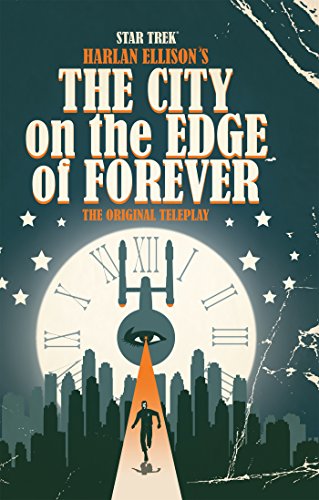
Star Trek: Harlan Ellison's City on the Edge of Forever, by Harlan Ellison, Scott Tipton, David Tipton, J.K. Woodward, Juan Ortiz

Download Ebook PDF Online Star Trek: Harlan Ellison's City on the Edge of Forever, by Harlan Ellison, Scott Tipton, David Tipton, J.K. Woodward, Juan Ortiz
For the first time ever, a visual presentation of the much-discussed, unrevised, unadulterated version of Harlan Ellison’s award-winning Star Trek teleplay script, “The City on the Edge of Forever!” See the story as Mr. Ellison originally intended!
Star Trek: Harlan Ellison's City on the Edge of Forever, by Harlan Ellison, Scott Tipton, David Tipton, J.K. Woodward, Juan Ortiz- Amazon Sales Rank: #32994 in eBooks
- Published on: 2015-03-04
- Released on: 2015-03-04
- Format: Kindle eBook
About the Author Harlan Ellison has written or edited more than 120 books and more than 1,700 stories, essays, and articles, as well as dozens of screenplays and teleplays. He has won numerous awards, including the Edgar Award, Hugo Award, an Audie Award for Best Solo Narration, and his fifth Nebula Award, breaking genre records. Ellison was named a Grand Master by the Science Fiction and Fantasy Writers of America in 2006. He lives in California.

Where to Download Star Trek: Harlan Ellison's City on the Edge of Forever, by Harlan Ellison, Scott Tipton, David Tipton, J.K. Woodward, Juan Ortiz
Most helpful customer reviews
26 of 26 people found the following review helpful. What's not to love? By Alt Harlan Ellison has always enjoyed playing the role of gadfly/curmudgeon, so his fans are well aware of his displeasure with changes made to his "City on the Edge of Forever" script for the original Star Trek. Even as altered, it was the best episode in the original series and one of the best episodes of any show ever to air.So is Ellison's original version better? In some ways, it is. The pivotal penultimate scene is the same, with a different character substituting for McCoy. Spock's memorable line -- "He knows, Doctor. He knows" -- doesn't appear but the scene retains all of its power. The bad guy gets a form of ironic justice to complete a storyline that doesn't exist in the version that aired.The original version adds depth to the characters. Spock and Kirk have more opportunity to discuss the philosophy of love, good and evil, and human nature. Spock and Kirk have more "bonding moments" in the original version.The beginning, which sends someone named Beckwith into the vortex instead of McCoy, is clever, but I'm not sure I prefer Beckwith to McCoy. The version that aired had both McCoy and Kirk going all swoony over Miss Keeler, which I kinda like. So there are good points to both versions, and I can only say that I'm happy both are available for fans to enjoy, even if only one was actually aired.I like the art quite a lot, but I'm even more amused by some of the background, including a sign on the outside of Tick Tock Man's that says "We serve Strange Wine every Shatterday." Gotta love that, as well as the unmistakable face of Harlan himself on one the characters. I assume the little things like that are a tribute to Ellison. In the end, I'm giving this 5 stars because it's well done and ... well, what's not to love about it?
23 of 24 people found the following review helpful. excellent adaptation of original script, highly recommended By B. Capossere “City on the Edge of Forever” is almost universally considered one of the best, if not the best, STAR TREK episodes. Famously penned by Harlan Ellison, and nearly as famously changed quite a bit, IDW Comics has come out with a comic of Ellison original Hugo-winning teleplay. Done in five installments via collaboration between Ellison and Scot and David Tipton, and illustrated by J.K. Woodward, the end result makes for a fascinating read that stands on its own with the eventually produced episode.The general plot is of course similar to the TV episode (warning, spoilers to follow, if one can spoiler a 40-year-old story). A crewmember from the Enterprise beams down to the planet below, travels through a time portal to 1930s America, and changes history (for the worse from the Enterprise’s perspective). Kirk and Spock, in order to set things right, go through the portal as well, where they meet Edith Keeler, whom Kirk falls in love with and then has to let die so history reverts back to its original course. Same basic story, but with significant differences in detail and tone.For instance, you know you’re not in Kansas anymore (or in the bright utopian Star Fleet world of Gene Roddenberry), when the opening scene involves a drug deal between two of the Enterprise’s crewmembers. Roddenberry had his vision of the future, and a highly successful one it was, but Ellison is more interested in mining the darker crevices of human nature, the ones that even if Roddenberry might admit still existed amongst the Star Fleet cadre he mostly didn’t care to share with the public.So while in the TV episode, it is Doctor McCoy who stumbles through the time portal thanks to being driven temporarily crazy by an accidental injection of medicine, here Ellison has his drug dealer, Beckwith, confronted by one of his buyers and turning violent before attempting to escape first by beaming down to the planet then by leaping through the time portal. This more grim, more “adult” tone lasts throughout the teleplay, with very little moderating humor or warmth.Some of the differences, though, are less an issue of vision than of pragmatics. The artwork here is often beautiful, and far more expansive than what we see on TV—for instance, we see our characters, um, trekking through a red desert, we see the actual Guardians in a valley of crystal, we even see the City on the Edge of Forever in its entirety, rather than a cramped archway with a few rocks around it (the name makes much more sense in the visual context offered here). Beautiful and expansive as it all is, though, it’s easy to see why the show’s budget couldn’t have allowed for all that.Nor could its time span of sixty minutes minus commercials have allowed for the pacing offered in the teleplay, certainly an improvement over the rushed nature of the show: we get a sense of the city’s isolation, the explanation by the Guardians is much more involved, and later characters and relationships are allowed time to develop more fully and realistically. These aren’t really criticisms of the TV show; it did what it could do within the constraints it had; it’s merely a recognition that a different medium offers up different opportunities.Another way this comes into play is in the depiction of how history has changed. In the show, the Enterprise is simply no longer there (certainly easy and cheap to film). Here, when the away team beams up they find the Enterprise is now “The Condor,” crewed by a rough and tumble motley group clearly not part of any organization at all, let alone Star Fleet. After a quick scrum, the away team secures the transporter room and Kirk and Spock leave them behind to hold it while they beam back down to try and go through the portal and change things back.This brings us to another refreshing change. The person Kirk tasks with holding the transporter room is Yeoman Rand, who takes on a much more pronounced and active role in the teleplay than she ever played on the series. It’s too bad this didn’t make it into the episode somehow, even if the backdrop of the Condor had to be dropped.The darker tone continues with Kirk and Spock’s arrival in the 1930s. In the TV show, we get some humorous by-play with a cop regarding Spock’s ears and an unfortunate rick-picking machine accident. But in Ellison’s version, we see some truly ugly xenophobia, as when one man rails about “a country run by the foreigners. All the scum we let in to take the food from our mouths. All the alien filth that pollutes our fine country.” It is the mob inflamed by this man that chases after Spock, a far cry from the benignly confused policeman of the TV show. In fact, throughout the original teleplay, the politics are played in a harsher, edgier, and I’d say, more realistic light.The latter half of the story focus on Kirk’s doomed relationship with Edith Keeler (literally the latter half—she first appears on page 50 of the 100 page text) and his relationship with Spock, who grows increasingly concerned the more Kirk becomes entwined with Keeler, telling Kirk at one point, “I have a theory, Captain, that the easiest place for a spaceman to ‘go native’ is his own world.” The artwork here does an especially nice job of conveying both relationships and their changes. In one scene, Spock and Kirk argue against a simple background that fades into gray then black, leaving the dialogue as a series of mostly floating faces, almost like black-clothed actors on a dark and bare stage. The starkness here is a perfect complement to the dialogue.Toward the end, a new character is introduced, a legless veteran of Verdun, and I won’t say much about him so as not to spoil events that differ from the television version, but as with Rand’s more active characterization, I wish the episode had found a way to work this character in.The story closes, as we know it does/must. That sense of inevitability, which was always one of the strengths of the TV episode, is here as well, even if it occurs in slightly different fashion. I have a small quibble with an even that happens upon their return through the time portal—it seemed unnecessarily distracting to me—but the end remains a devastating close to one of the more emotional STAR TREK episodes ever. Two versions of the same tale, equally effective. Highly recommended.
11 of 11 people found the following review helpful. A five-star keeper By VoiceOfReason This graphic novel adheres VERY closely to Ellison's original script -- which can be found in paperback, here on Amazon, with a long and fascinating essay ("Perils of the City") that reveals who wrote what (Ellison wrote the original treatments and script, and first revision) and when (three others, none of them Roddenberry) -- and everyone does a bang-up job with the adaptation. The writing/adaptation by the Tiptons is terrific. The standard covers, for each of the five original issues, by Ortiz -- especially the cover for issue #1, which graces this graphic novel collection -- are as funky and fun and as art deco as ever (and they are included herein, as are the "special covers" by Paul Shipper, featuring paintings of Trek characters from the classic TV show). Woodward's Illustrations inside are sublime. He even includes "Easter Eggs" for his friends and, when he began to loosen up by issue or part 3, after getting positive feedback from Ellison himself, tosses in "Ellison eggs" (references to some of Ellison's short stories in the form of signs and writing and graffiti, and at least one illustration of what looks like Blood as he appeared in the '74 movie adaptation of "A Boy and his Dog"). Even Harlan's visage makes an appearance, when a certain WWI vet rolls onto the stage.Bonuses with the hardcover include a new intro and afterword by Harlan Ellison as well as copious artist notes from JK Woodward, regarding his method of working -- interesting even to those not inclined to draw or paint -- as well as about the series itself (pointing out the various "eggs", and methods he used to illustrate various scenes, including one that involves an electric toothbrush that made me fall off my seat).Yeah, the revised ending -- AKA the televised version -- had its moments, and yeah the ending there worked quite well on a visceral level. But the original ending, as well as an in-depth discussion between Kirk and Spock about love, the broaching of racism and xenophobia that Ellison originally wrote into the teleplay are all sorely missed. It seems that Roddenberry and his minions preferred the visceral over the intellectual. More's the pity. On the other hand, this graphic novel -- because comic books are basically storyboards with more detailed illustration and dialogue -- allows those who enjoyed "Star Trek" as well as anyone who enjoys good writing to finally have the brilliant, WGA-award winning script play out before their eyes. And they can still go back and enjoy the revised/televised version if they so choose.And, of course, the illustrations are larger in this version, since the graphic novel/book is larger than the comic format, which makes Woodward's illustrations even more beautiful to be hold.This one's a five star keeper, folks.
See all 79 customer reviews... Star Trek: Harlan Ellison's City on the Edge of Forever, by Harlan Ellison, Scott Tipton, David Tipton, J.K. Woodward, Juan OrtizStar Trek: Harlan Ellison's City on the Edge of Forever, by Harlan Ellison, Scott Tipton, David Tipton, J.K. Woodward, Juan Ortiz PDF
Star Trek: Harlan Ellison's City on the Edge of Forever, by Harlan Ellison, Scott Tipton, David Tipton, J.K. Woodward, Juan Ortiz iBooks
Star Trek: Harlan Ellison's City on the Edge of Forever, by Harlan Ellison, Scott Tipton, David Tipton, J.K. Woodward, Juan Ortiz ePub
Star Trek: Harlan Ellison's City on the Edge of Forever, by Harlan Ellison, Scott Tipton, David Tipton, J.K. Woodward, Juan Ortiz rtf
Star Trek: Harlan Ellison's City on the Edge of Forever, by Harlan Ellison, Scott Tipton, David Tipton, J.K. Woodward, Juan Ortiz AZW
Star Trek: Harlan Ellison's City on the Edge of Forever, by Harlan Ellison, Scott Tipton, David Tipton, J.K. Woodward, Juan Ortiz Kindle

Tidak ada komentar:
Posting Komentar